Search for Flights
 Search for Hotels
 Check Exchange Rates
 Check the Weather
Beyond Kyoto to Hyogo: A 4-Day Kansai Journey Through Chirimen Silk, Hot Springs & Forest Trails
Last update
Most travelers don’t realize how different Kansai feels when you leave the well-known cities. In central Kyoto and Osaka, life moves at city speed, but head north toward the Sea of Japan and the air changes.
This four-day Kansai itinerary travels through Miyama, Tango, Toyooka and Yumura in Tajima, and Tamba — revealing how water connects silk craftsmanship, hot spring life, mountain villages, and coastal landscapes across Kyoto and Hyogo Prefectures.
Day 1 – From Rural Streams to the Silk Coast
Miyama ─ A Village Built Around Water (Miyama Town, Nantan City, Kyoto Prefecture)
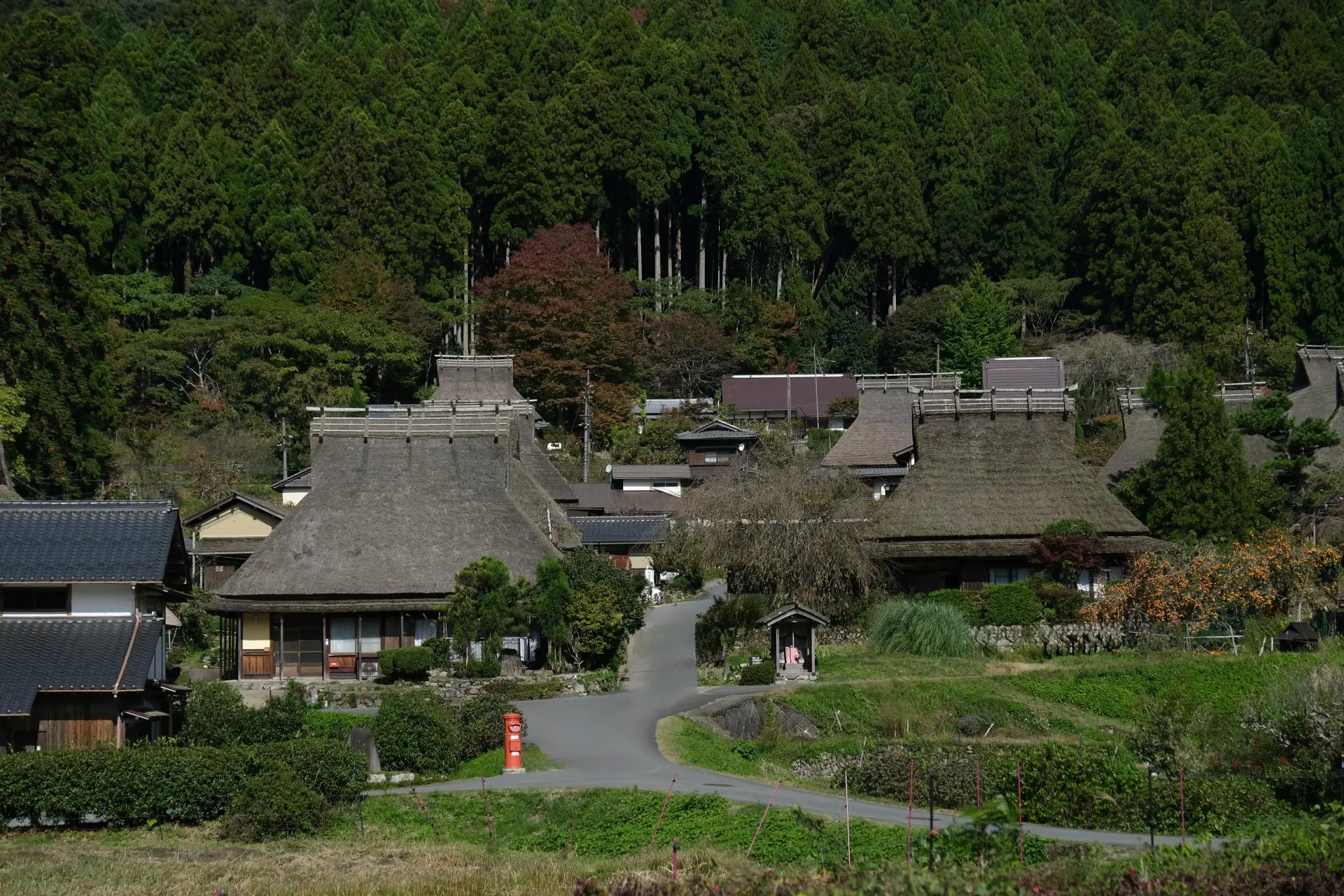
In the mountains of northern Kyoto, Miyama is one of Japan’s best-preserved thatched-roof villages (kayabuki no sato) and an ideal rural day trip from Kyoto.

Unlike folk villages designed for tourism, Miyama is still lived-in — we saw the postman delivering mail, laundry drying outside, and farmers preparing for a new day.

You can visit Miyama Folklore Museum to see the interior of a traditional thatched house: old F, kitchen utensils, and daily farming equipment — a quiet glimpse into countryside life before modern conveniences.

Thanks to clean mountain water and rich pastures, Miyama is also known for high-quality dairy products. At a small farm shop, we tried fresh Miyama milk gelato — surprisingly floral and creamy, possibly one of the best in Japan.

For travelers seeking slow travel and farm-to-table experiences, Miyama offers an authentic look at rural Japan.
TANGO OPEN CENTER ─ The Heart of Japan’s Chirimen Silk (Kyotango City, Kyoto Prefecture)
Traveling north, the Tango Peninsula reveals one of Japan’s most important silk production regions. For over 300 years, Tango has produced Tango Chirimen, a crepe-style silk used by Kyoto dyeing artisans and luxury fashion houses in Paris.

At the TANGO OPEN CENTER, visitors can learn how chirimen is made step by step — from raw silk to finished textile.

Unlike regular silk, Tango Chirimen is woven with twisted threads in opposite directions, then washed in hot water to relax the fibers. As the tension slowly releases, the surface develops natural ripples called shibo — the signature matte finish of Tango Chirimen. The process remains delicate and largely dependent on the artisan’s eye.
Yuhigaura Beach – Kyoto’s Best Sunset on the Sea of Japan (Kyotango City, Kyoto Prefecture)
Just a short drive away, the road opens to Yuhigaura Beach, known for its seaside swings facing the horizon.

It has become a popular photography spot and one of Kyoto’s most peaceful sunset views — especially on clear days.
Ichibokan – Onsen by the Sea of Japan (Kyotango City, Kyoto Prefecture)
Right by the beach lies Ichibokan, a coastal ryokan known for sea-view hot springs and fresh seafood sourced directly from local fishing ports.

It is an ideal place to stay for both onsen lovers and travelers who come for the food.
Day 2 – Handcrafted Lanterns & Geopark Landscapes
Kojima-an – Japanese Lantern Crafting in Kyotango (Kyotango City, Kyoto Prefecture)
We headed to Kojima-an for a hands-on Japanese lantern-making workshop using washi — Japan’s traditional handmade paper.

Before shaping the lantern, washi fibers are softened in water, allowing them to stretch without tearing.

Once dried around a wooden frame, the paper becomes surprisingly durable — able to last for decades.
Genbudo Park & Museum – UNESCO Geopark Experience (Toyooka City, Hyogo Prefecture)
Next, we traveled to Toyooka in Hyogo Prefecture — just across the border from Kyoto. Here, you’ll find one of Japan’s most impressive geological sites: Genbudo Park. Genbudo is part of the San’in Kaigan UNESCO Global Geopark.

Around 1.6 million years ago, lava flowing from a volcano cooled rapidly, forming near-perfect hexagonal basalt columns. Today, they rise like a massive stone temple, creating a breathtaking landscape that overlooks the river below.

Genbudo helped scientists prove geomagnetic reversal in 1926, leading to the Plate Tectonics Theory, one of the biggest scientific discoveries of the 20th century.
The Genbudo Museum, located across the road, features exhibits of minerals and fossils from around the world, along with displays of Toyooka Kiryu Zaiku, a traditional wicker craft that will be introduced in more detail later.
Sightseeing Boat Ride – River Views & Rare Wildlife
If you want to more deeply experience the unique landscape and scenery of Toyooka shaped by the flow of the Maruyama River, a mini sightseeing boat ride is highly recommended.

Toyooka is also home to the Oriental White Stork, once extinct in Japan but successfully reintroduced through conservation efforts — a rare sight for wildlife lovers.
Toyooka Kiryu (Willow) Craft – Wicker Craft Shaped by Water and Air
Inside the Genbudo Museum, visitors can also learn about Toyooka Kiryu (willow) craft, a traditional handicraft of the region. It is made using kori-yagi willow and rattan that once grew naturally in the wetlands of the Maruyama River basin. The materials are soaked in water to soften them, then carefully woven by hand, making the most of their natural flexibility. These traditional techniques, passed down through Toyooka’s climate and way of life, result in sturdy baskets once the pieces are fully dried.

We even tried making a small wicker coaster during the workshop. it is woven with willow in the center circle.

We even tried making a small wicker coaster during the workshop. it is woven with willow in the center circle.
Yumura Onsen – Hot Springs as Daily Life (Shinonsen Town, Mikata District, Hyogo Prefecture)
After a light lunch at the Genbudo Museum, we continued deeper into Hyogo Prefecture and arrived at Yumura Onsen, founded in 848 — not just a resort town, but a living community.

Here at Arayu, the 98°C natural hot spring is part of everyday life. Thanks to the abundant supply of onsen water in Yumura Onsen, hot spring water is delivered directly to local homes, where residents use it for cooking and even doing laundry. Visitors are welcome to try the yugaki experience by boiling eggs or vegetables themselves — a rare glimpse of how hot springs once shaped daily routines across Japan.

Strolling through Yumura’s retro streets, you’ll come across Yumechiyo Hall, which displays photographs and everyday items from the Showa era and preserves the atmosphere of Yumechiyo Nikki, a drama set right here in Yumura Onsen.

For the night, we stayed at Kasenkyo Izutsuya, known as “the hot spring that warms you to the bone.” Its mineral-rich hot spring water retains warmth long after bathing — even on a cold winter walk outside.

Dinner here features Tajima beef and seafood from the Sea of Japan, served kaiseki-style under the guidance of Contemporary Master Craftsman Inoue Akihiko.
Day 3 – Takeda Castle & Rural Cuisine
Tojikan – Morning Sake & Spring Water (Shinonsen Town, Mikata District, Hyogo Prefecture)
Before leaving Yumura Onsen, we stopped at Tojikan, a small exhibition space located just steps from the Arayu hot spring source.

Inside, visitors can see traditional sake-making tools and enjoy tasting sake brewed by Tajima Toji, one of Japan’s four major master brewer groups, while listening to stories from former toji craftsmen (available for a limited time ,dates irregular). It is truly a spot unique to the home of Tajima Toji.
Tajima Beef Museum – Understanding the Taste of the Land (Shinonsen Town, Mikata District, Hyogo Prefecture)
From Yumura, we continued our drive to the Tajima Beef Museum, which introduces the science and history behind one of Japan’s most influential cattle breeds. Some of the staff here have real experience in cattle farming, so their explanations go beyond displays!

Tajima cattle are important, as they are the original bloodline of Kobe beef and the foundation of modern Japanese wagyu. By law, all certified Kobe beef must come from Tajima cattle born and raised in Hyogo Prefecture — meaning that the roots of Japan’s wagyu culture begin in this region.

After the visit, we had a light lunch using local beef, which helped us understand the taste not as “luxury cuisine,” but as something shaped by nature, science, and generations of agricultural knowledge.
Takeda Castle – Watching Over the River Valley (Asago City, Hyogo Prefecture)
Rising 353 meters above sea level, Takeda Castle — often called Japan’s Castle in the Sky — sits on a mountaintop overlooking the river valley of northern Hyogo.

Built in the 15th century, it was strategically positioned to control key waterways used to transport goods and send messages. During the Toyotomi regime, Takeda Castle gained importance as a stronghold to protect the Ikuno Silver Mine. It is said that Toyotomi Hideyoshi’s younger brother, Hidenaga, set the course for transforming Takeda Castle into a fortress built entirely of stone walls while serving as castle governor, and that Akamatsu Hirohide—Hideyoshi’s retainer and the castle’s final lord—ultimately completed it.

Many travelers visit at sunrise to see the castle surrounded by a “sea of mist” — when the cool river air meets warmer mountain temperatures, creating a cloud-like blanket. Even without fog, the atmosphere is powerful — especially when the wind changes as you climb higher!
Shuraku Maruyama – Rural Life As It Is (Tamba-Sasayama City, Hyogo Prefecture)
Deep in Tamba-Sasayama, Hyogo Prefecture, lies Kominka Inn Shuraku Maruyama — more than a hotel, it is a restored hamlet of 100–150-year-old houses rebuilt using traditional timber.

Each home retains its thick wooden beams and pillars, creating a quiet atmosphere where time seems to stand still. Breakfast is a simple, heartwarming satoyama-style meal prepared by women from the neighborhood.

It’s a rare place surrounded by farmland, forests, and clear spring water, where you can experience life in a traditional Japanese rural village just as it once was.
Hiwa no Kura – Local Flavors
From the inn, you can walk to dinner via a village road — listening to crickets and flowing water from nearby fields. At Hiwa no Kura, the chef builds each course from what the landscape allows: vegetables grown by local farmers, seafood from Awaji Island, and beef raised in clean mountain air.

The menu changes seasonally and blends Japanese ingredients with refined French techniques.

Simple from the outside, but deeply intentional within — it was one of the best meals we have had in a long time.
Day 4 – Hands-on Cooking & Bamboo Paths
Eitakuji Soba Dojo – Learning to Cook Soba (Sanda City, Hyogo Prefecture)
Our final day begins with dough instead of sightseeing. At Eitakuji Soba Dojo, visitors make soba noodles from scratch — mixing buckwheat flour, adding water little by little, kneading, rolling, and cutting with a traditional soba knife.

Here we learned how mineral content and water hardness affect the dough. In some regions, it breaks easily, in others, it becomes sticky. The water in this area holds an ideal balance — giving its satisfying chew.

Eating noodles you made yourself feels so rewarding!
Bamboo Forest Cycling – Alternative to Arashiyama (Muko City, Kyoto Prefecture)
Instead of Arashiyama’s crowds, Muko city of Kyoto has a peaceful cycling route called Take no Michi (The Bamboo Path).

Bamboo stretches for hundreds of meters, forming a natural green tunnel with no souvenir shops — only wind moving through the stalks.

We rented electric-assist bikes from a local shop near the station and rode slowly through gently rolling hills. Instead of rushing between landmarks, the charm lies in being able to stop freely wherever you feel like taking photos.
Kimono Tea Ceremony MAIKOYA – Beginner Cultural Experiences (Kyoto City, Kyoto Prefecture)
Back to Kyoto City, Kimono Tea Ceremony MAIKOYA offers accessible workshops like tea ceremony and kimono dressing — a good addition for first-time visitors to Japan.

During our visit, the staff mentioned ichigo ichie — the Japanese idea that every moment is unique and never repeated — a meaningful way to reflect on this four-day journey through Kansai.
Conclusion – A Journey Through Kansai, Connected by Water — From Kyoto to Hyogo
This itinerary shows how water shapes Kansai’s identity - from silk refining and hot springs to rural cuisine and river valleys. It is more than a journey between places; it is a way to understand how land, craft, and local life are connected through water.
Check also...

You can enjoy Kyoto’s hugely popular spot, Fushimi Inari Taisha Shrine, virtually! Vol. 4
Ise-Shima and Iga: Tracing the Miketsukuni Route From Sea to Clay
Wakasa to Kyoto: Tracing the Miketsukuni Route on the Mackerel Highway
Tea Fields to Kyoto Tables: A Journey Through Wazuka and Fushimi
Tides and Traditions of Awaji: Tracing the Miketsukuni Route From Japan’s Sacred Island
Wakasa to Kyoto: Tracing the Miketsukuni Route from Sea to Court
A Journey Through Nagaokakyo: Tracing the Miketsukuni Route From Kilns and Kyoto Traditions